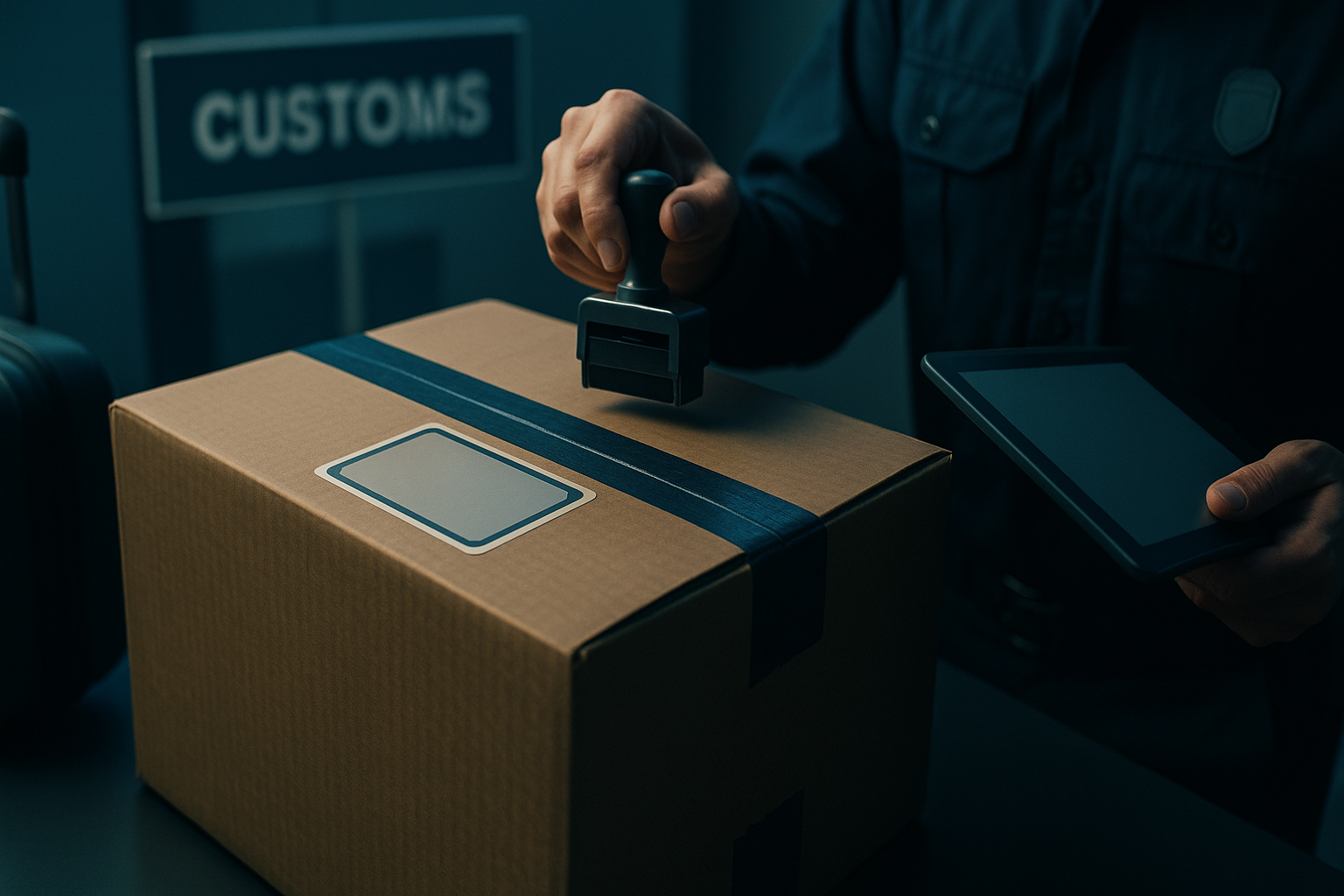
Customs clearance is the process by which US Customs and Border Protection (CBP) reviews, classifies, and either releases or holds an incoming international shipment. Every package crossing the US border — regardless of size, value, or shipping method — must pass through this process.
For traditional importers bringing in containers, this is routine. For dropshippers shipping hundreds of individual orders daily direct from Chinese suppliers to US customers, it's a different beast: you're dealing with high-frequency, low-value parcel flows, each one theoretically requiring its own customs entry. As one customs specialist puts it, the model now requires the same filing infrastructure as a container shipment, amortized across one unit instead of five thousand.
That asymmetry is exactly why the rule changes of the past year have hit dropshippers harder than any other e-commerce model.
Here's what actually happens between your customer clicking "Buy" and the package landing on their doorstep:
In many cases, the review is automated. But shipments with inconsistent data, suspicious valuation patterns, or missing documentation are flagged for manual inspection — adding days or weeks to delivery.
This is the single most important shift Shopify sellers sourcing from China need to understand.
For over two decades, the Section 321 de minimis rule allowed packages valued under $800 to enter the US duty-free with minimal documentation. This was the economic engine powering direct-to-consumer dropshipping from China — roughly 4 million packages per day entered the US under this rule, bypassing import duties entirely.
"The administrative model that made $12 products profitable no longer exists." — Elevated Magazines, US Customs Guide for Dropshipping
On May 2, 2025, Executive Order 14256 suspended de minimis treatment specifically for goods of Chinese and Hong Kong origin. Since August 29, 2025, the suspension was expanded to commercial shipments from all countries, and in June 2026, CBP codified the suspension indefinitely. Today, every commercial shipment entering the United States — regardless of value — requires formal customs entry, a 10-digit HTS classification, and full duty payment.
The practical cost impact is real: a product that used to clear duty-free now requires a customs broker filing on top of applicable duties. For low-ticket items, that math can quickly erode or eliminate margins entirely.
Tariffs on Chinese goods don't come from a single rate — they stack. Here's how the layers work today:
| Tariff Layer | Rate | Applies To |
|---|---|---|
| Base HTS duty (MFN rate) | 0% – 37.5% (typically 2.5–6% for consumer goods) | All imports, by product category |
| Section 301 tariff (Lists 1–3) | 25% | China-origin goods on Lists 1, 2, 3 |
| Section 301 tariff (List 4A) | 7.5% | Electronics, homeware, clothing, accessories |
| Section 301 forced-labor duty (from July 24, 2026) | +12.5% additive | China-origin goods (stacked on top of list duties) |
| Customs broker / entry fees | Typically $125–$300 per entry | Every shipment requiring formal entry |
On Lists 1, 2, and 3, the aggregate China tariff rate now reaches 37.5% (25% list duty + 12.5% forced-labor addition) before the base HTS rate is applied. On List 4A products — which covers a large slice of typical e-commerce categories — the aggregate Section 301 rate is 20%. These rates are additive: your total landed cost includes all applicable layers.
Note: the USTR extended 178 Section 301 exclusions through November 10, 2026, so some product categories may qualify for partial relief. Check the USTR exclusions list against your specific HTS code before assuming you're fully exposed.
This is the question most dropshippers avoid — and the one CBP will force you to answer.
Dropshipping creates natural confusion around importer responsibility. Multiple parties are involved: you (the Shopify seller), your Chinese supplier, your US customer, and potentially a marketplace or fulfillment agent. CBP requires a clearly designated Importer of Record — the entity legally responsible for the accuracy of all entry documentation and the payment of all duties.
As the IOR, you are responsible for:
Using a customs broker doesn't eliminate your liability. The broker acts as your agent; you remain the principal responsible for the entry's accuracy. Misclassification, even if unintentional, can trigger audits, duty assessments, and fines traced back to you.
Every product entering the United States must be assigned a Harmonized Tariff Schedule (HTSUS) code. This 10-digit code determines your duty rate, your exposure to Section 301 China tariffs, your eligibility for any remaining trade exclusions, and your risk of CBP examination.
Common classification mistakes to avoid:
If you're sourcing from multiple Chinese platforms — 1688, Taobao, Weidian, Tmall — and scaling to dozens or hundreds of SKUs, HTS classification at scale becomes a serious operational challenge. Tools like Piratify's sourcing workflow are designed to bridge the gap between raw supplier listings and compliant product data, including origin documentation.
For informal entries (shipments valued between $0 and $2,500, the pathway most former Section 321 shipments now use), CBP requires:
For formal entries (shipments over $2,500), the requirements expand further to include a commercial invoice, packing list, and potentially certificates of origin or product-specific compliance documentation depending on the product category.
Partner Government Agencies (PGAs) like the FDA, CPSC, or FCC may impose additional requirements on certain product types — electronics, food-adjacent items, cosmetics, children's products. If your category triggers a PGA, missing the corresponding certification or labeling compliance can hold your shipment indefinitely.
Under the old de minimis regime, most consumer packages cleared automatically within 1–3 days at an ISC (International Service Center) facility with no action required. That speed was the system working as designed — minimal data, minimal friction.
Under the current formal/informal entry regime, timing depends on data quality and inspection risk:
For Shopify sellers promising fast delivery to US customers, these potential delays are a customer experience risk — which is why getting documentation right on every shipment matters operationally, not just legally.
The sellers who are navigating this landscape successfully have made specific operational shifts — not just absorbed higher costs.
For a deeper look at how shipping lead times and carrier selection interact with customs risk, see our guide on China-to-US shipping options for dropshippers.
No — you don't need a customs broker license to run a dropshipping business. Only businesses that provide customs clearance services to others as a commercial offering need broker licenses. As a dropshipper, you're importing for your own business. However, you will almost certainly need to work with a licensed customs broker to handle your entry filings correctly, especially now that every shipment from China requires formal entry regardless of value.
The Importer of Record (IOR) is legally responsible for paying all applicable import duties. In most dropshipping setups, that's you — the Shopify seller — not your Chinese supplier, and not your end customer (unless you've explicitly structured a Delivered At Place arrangement where duty is the buyer's responsibility, which is uncommon in B2C dropshipping).
No. The de minimis exemption for commercial goods from China has been suspended since May 2025 and codified as indefinitely suspended by CBP in June 2026. Every commercial shipment from China — regardless of declared value — now requires formal or informal customs entry with full HTS classification and duty payment. Section 321 technically remains in US law, but the executive branch's discretion to grant duty-free treatment under it has been revoked for Chinese-origin commercial goods.