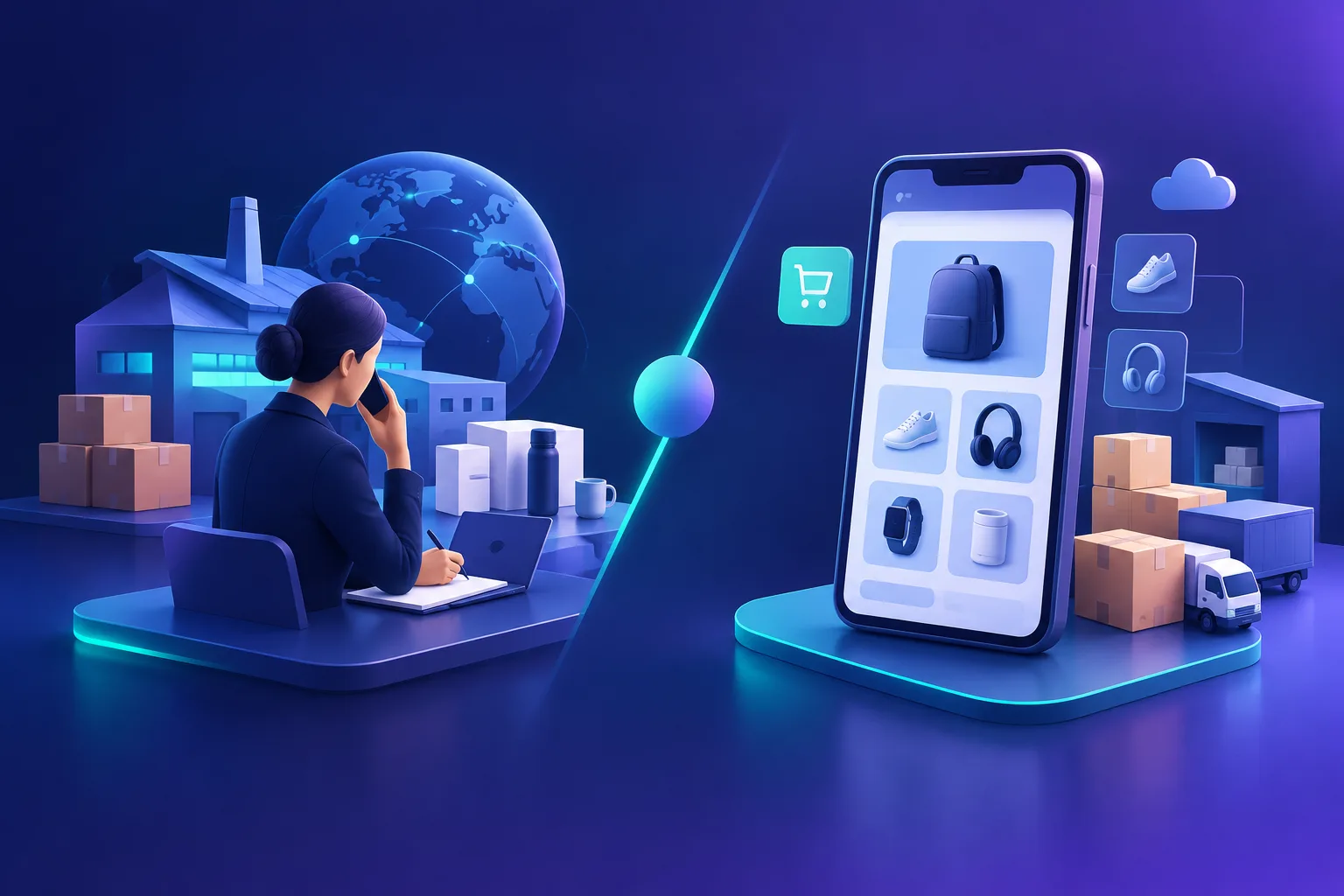
Here's the thing nobody tells you upfront: 1688 and Tmall were never designed to compete with each other. They solve completely different problems, serve different customers, and operate on different commercial logic. Picking the wrong one for your private label project doesn't just cost you money — it costs you months.
1688 is a domestic Chinese B2B wholesale marketplace. Tmall is a curated B2C platform for brand-authorized stores selling to Chinese consumers. When you're sourcing for a Shopify private label brand, these aren't two roads to the same destination. They're two different destinations entirely.
1688.com is Alibaba's domestic-market wholesale platform — a place where Chinese retailers, resellers, and manufacturers buy inventory at domestic wholesale prices. Because suppliers are selling to the local market, there's no English-language overhead and no export-facing markup built into the listing price. That's the core reason international buyers pay attention to it.
In practical terms, 1688 is where you'll find manufacturers willing to discuss custom logos, packaging, materials, and OEM/ODM requirements. It's a genuinely powerful sourcing channel for private labeling — if you can navigate it. The catch: the platform is entirely in Chinese, quotes are in RMB, and most suppliers won't handle export logistics or communicate in English without a China-side intermediary.
Tmall is best understood as China's premium retail mall — brand-authorized stores only, verified sellers, consistent product quality. It's where Chinese middle-class consumers go to buy authentic goods they trust. If your goal is to sell into the Chinese market under your brand, Tmall Global is a legitimate channel. But if your goal is to source products to manufacture under your label? Tmall is the wrong tool entirely.
Tmall doesn't have factory-to-buyer wholesale mechanics. There's no MOQ negotiation, no OEM/ODM discussion, no ability to request custom packaging at scale. What you see is what you get: retail products at retail prices, from sellers who are themselves already brands.
"1688 is the most worthwhile for stocking up to sell seriously" — while Tmall is designed for authenticated brand retail, not manufacturer sourcing. The distinction matters enormously for your margin structure.
| Criteria | 1688 | Tmall |
|---|---|---|
| Platform type | B2B domestic wholesale | B2C brand retail |
| Typical sellers | Factories, wholesalers, trading companies | Official brand stores only |
| Price level | Lowest (domestic wholesale rates) | Medium to high (retail prices) |
| MOQ | Usually 1–50 units; negotiable at scale | 1 unit (no wholesale MOQ structure) |
| Custom branding / OEM | Yes — widely available | No — products are pre-branded |
| Custom packaging | Negotiable with suppliers | Not applicable |
| Language | Chinese only | Chinese (some international support) |
| Export readiness | Low — needs agent or intermediary | Low — domestic platform |
| Buyer protection | Limited for overseas buyers | Strong (within China) |
| Best use case | Private label sourcing, wholesale inventory | Buying authenticated branded products |
For private label sourcing, 1688 wins — and it's not close. The platform gives you access to the same upstream manufacturers that supply major Tmall brands, Amazon private label sellers, and physical retailers globally. You're cutting out the middlemen who markup domestic wholesale prices before re-listing them on Alibaba.com or AliExpress.
Here's what makes 1688 specifically strong for private label:
The honest caveats are real, though. A significant share of 1688 sellers are trading companies or distributors, not the factories themselves — so vetting matters. And without a China-side agent or tool, the language barrier, RMB payments, and domestic-only shipping make 1688 practically inaccessible for most international Shopify sellers.
For a deeper look at how 1688 stacks up on pure pricing, this breakdown of Taobao vs 1688 unit economics is worth reading alongside this comparison.
There's one scenario where Tmall legitimately belongs in your China sourcing strategy: competitive intelligence and product benchmarking.
Tmall's brand stores often represent the finished, polished version of a product category — packaging standards, product specifications, and consumer positioning you can reverse-engineer when briefing your 1688 suppliers. If you want to understand what a premium version of your product looks like in the Chinese market, Tmall shows you. You then go to 1688 to manufacture it.
A second edge case: if you're sourcing a product category where authentication genuinely matters — certain electronics components, certified materials, licensed ingredients — Tmall's verified seller model reduces grey-market risk in a way 1688 can't match.
This is the part that makes or breaks private label sourcing on 1688. The platform's price advantage is real and documented — but it was designed for Chinese domestic buyers, not international e-commerce sellers. In practice, this creates three friction points:
This is precisely where a platform like Piratify closes the gap — handling 1688 sourcing, supplier communication, and fulfillment as an integrated workflow, so Shopify sellers can access domestic Chinese pricing without needing boots on the ground in China. The sourcing and fulfillment are managed in-house, not patched together through third-party services.
If you're also evaluating how platforms like Goofish or Weidian fit into a broader China sourcing mix, this guide to China sourcing platforms for Shopify sellers covers the full landscape.
The right answer depends on where you are in your brand-building journey, not just what the platforms offer in theory.
The strongest private label brands don't choose between platforms arbitrarily — they use 1688 to manufacture and Tmall to benchmark. That's the real workflow.
No — Tmall is a brand retail platform, not a manufacturer marketplace. Sellers on Tmall are authorized brand stores, not factories offering OEM or ODM production. For private label sourcing (custom branding, packaging, specifications), 1688 is the correct platform, where you can find manufacturers willing to discuss logos, materials, and custom production runs.
Generally yes, in terms of unit cost — but the comparison is almost apples and oranges. Tmall sells finished, branded retail products at retail prices. 1688 sells wholesale or near-factory pricing on unbranded or customizable goods. Once you add domestic freight, agent fees, international shipping, and customs into the 1688 landed cost, the pure per-unit gap narrows. That said, for volume private label orders, 1688 consistently delivers lower all-in costs.
In practice, yes — especially for private label orders. The platform is Chinese-only, payments are RMB-denominated, and suppliers ship domestically. An agent (or an integrated sourcing tool) handles supplier communication, quality inspection, payment, and the export logistics step. Trying to manage 1688 directly from abroad without China-side support leads to communication breakdowns, payment friction, and fulfillment delays that erase the cost savings.