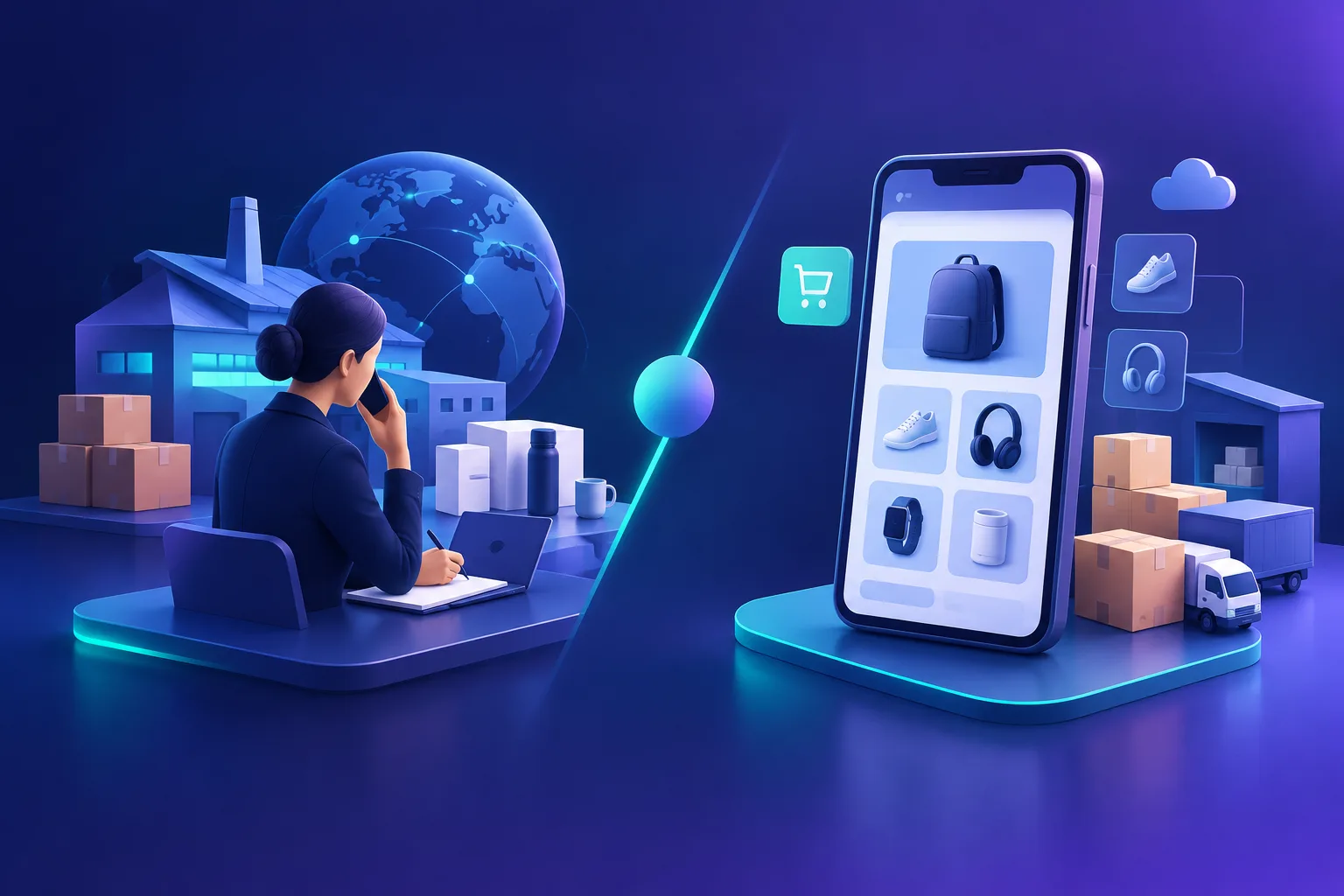
Before you can pick the right option, you need to understand what each one actually does — because the naming gets blurry fast.
A human sourcing agent is a person (or small team) based in China who acts as your procurement partner. They negotiate with factories, verify suppliers, arrange sample runs, inspect goods before shipment, and coordinate packaging. Communication usually happens over WeChat, email, or WhatsApp, one conversation at a time.
A Shopify sourcing app is a software layer between your store and a product or supplier network. You browse a catalog (or search a marketplace), import products with a click, and orders route automatically from your Shopify checkout to the supplier — no human intermediary required on your end.
The useful question is not "Which model is better?" — it's "Which model fits the stage of this product?"
Both can get products from China to your customers. They differ sharply on how, at what cost, and for whom.
| Criterion | Human Sourcing Agent | Shopify Sourcing App |
|---|---|---|
| Setup speed | Days to weeks (vetting, onboarding) | Minutes to hours |
| Product range | Anything you can describe — fully custom | Limited to catalog or supported platforms |
| MOQ | Varies — often requires bulk commitments | Usually none (single-unit fulfillment) |
| Pricing access | Factory-direct; can be 10–30% cheaper at volume | Retail or near-retail; intermediary markup built in |
| Quality control | Physical inspection at agent warehouse | Varies; minimal QC on most catalog apps |
| Automation | Low — manual or semi-manual workflows | High — order routing, tracking sync, stock updates |
| Private label / branding | Strong — negotiated directly with factory | Limited; only some apps support custom packaging |
| Scalability | Capped by agent capacity and bandwidth | Scales with your order volume automatically |
| Cost model | Commission (typically 3–10%) or all-in quote | Monthly SaaS fee or per-order fee |
| Risk if things go wrong | Agent is accountable; relationship-based | Platform support; dispute resolution varies |
Speed and automation are the sourcing app's biggest advantages. You can connect to Shopify, import a product, and start selling the same day. There's no vetting process, no back-and-forth over quotes, and no time-zone gap to navigate.
Apps shine when you're in product-testing mode. You haven't validated demand yet, so committing to bulk inventory — which a human agent often requires — would be financially reckless. Most sourcing apps fulfill single-unit orders on demand, meaning you only pay for what your customers have already bought.
Apps like DSers (AliExpress-based), Spocket, AutoDS, or CJ Dropshipping are built exactly for this phase. They lower the barrier to entry dramatically — at the cost of sourcing depth and margin control.
The trade-off? Catalog-based sourcing apps typically tap retail or near-retail marketplaces, which means the unit price you pay includes an intermediary's markup. At low volumes that's acceptable. At scale, it quietly kills your margins.
Once a product proves itself, the economics shift. A human agent with direct factory relationships can negotiate unit costs that catalog-driven apps simply can't match — often 10–30% lower at comparable volumes. That gap compounds fast when you're shipping hundreds of orders a week.
Agents also own the quality layer in a way apps can't replicate. They physically inspect goods at a China-side warehouse before shipment, catch defects early, and manage rework with the factory directly. For branded products or anything with aesthetic standards, this matters enormously.
The friction is real, though. Finding a reliable agent is easy — there are thousands. Vetting one properly takes time, and the risk is concentrated in that vetting phase. Fee structures vary: some agents charge a commission on the product cost, some give you an all-in landed price (where their margin is baked in and invisible), and some charge a monthly retainer that only makes sense at serious volume.
One classic red flag: any agent asking for an upfront "membership fee" before a single order is placed. Walk away.
The binary choice between "app" and "agent" is becoming outdated. A new category has emerged that combines the automation and Shopify integration of a sourcing app with access to factory-direct Chinese platforms — the places where prices are closest to the source.
Platforms in this space give you direct search access to marketplaces like 1688, Taobao, Tmall, JD.com, Goofish, and Weidian from inside your Shopify workflow. These platforms are in Chinese, require local payment methods, and assume knowledge of Chinese trade norms — barriers that historically made them accessible only through a human agent. Bridging that gap programmatically is precisely what tools like Piratify are built for, with built-in fulfillment handling the logistics end-to-end so you're not stitching together a separate agent relationship on top.
For sellers who want the cost advantages of factory-direct China sourcing — without the friction of managing a human agent or the retail-level pricing of catalog apps — this middle path is increasingly the pragmatic choice. You can read more about accessing these platforms directly in the full guide on what sourcing agents actually do and when you need one.
Rather than picking a model forever, think about where your store sits right now:
Validate demand through low-friction automation. Lock in margin through direct sourcing. The two are not in competition — they're sequential.
Human agents come with a time cost that rarely appears in comparisons. When something goes wrong — a shipment delayed, a batch with quality issues, a supplier who goes dark — you are the one managing that relationship across a language gap and a 7-to-12 hour time difference. For a solo operator running multiple products, this overhead can eat more hours per week than it saves in unit cost.
Apps, conversely, shift that risk to the platform's support infrastructure. Whether that infrastructure is good enough is a platform-specific question, but at least the burden isn't solely on you to resolve it manually.
Factor this into your decision honestly. Agent pricing looks better on a spreadsheet. Reality includes the Friday-night crisis messages and the disputed QC batches.
Yes — and many experienced sellers do exactly that. A sourcing app handles new product testing with zero inventory risk, while a human agent manages the one or two proven SKUs where factory-direct pricing and QC are worth the effort. The two models are complementary, not mutually exclusive.
At low volumes, yes — the SaaS fee model beats agent commissions when order counts are small. At higher volumes, the math often flips: agent-sourced factory pricing can undercut app catalog prices by enough to more than cover the commission. Run the numbers on your actual SKU cost, not on averages.
Vetting. There are thousands of people calling themselves sourcing agents, and the quality gap between a reliable partner and a poorly organized intermediary is enormous. Check references from other Shopify sellers in the same niche, request a factory quote on a product you can cross-reference, and treat any upfront membership fee as an immediate disqualifier.